What Is ISO?
The International Organization for Standardization (ISO) is an independent, non-governmental international organization that brings together national standards bodies from countries around the world. ISO develops international standards covering products, processes, services, management systems, and many other areas of business and industry.
ISO has been developing international standards since 1947. Today, its standards cover a very wide range of subjects, from technical specifications and testing methods to quality, environmental management, information security, food safety, and more.
One slightly unusual fact is that “ISO” is not actually an acronym. The organization uses ISO as its universal short name, derived from the Greek word isos, meaning “equal”. The name avoids having different initials in different languages.
ISO develops standards, but it does not generally inspect individual products or certify companies itself. For example, ISO does not tell a factory exactly how to manufacture a plastic component, inspect individual injection-moulded parts, or issue an ISO 9001 certificate to a company.
The standards are developed through an international consensus process involving experts from relevant industries, national standards organizations, and other interested parties. They are intended to provide a common point of reference that can be used across countries and industries.
This is particularly useful in international manufacturing. A company in Germany, Lithuania, Poland, the United States, or elsewhere may operate under different national laws and business practices, but an internationally recognized management standard gives customers and suppliers a common basis for understanding how an organization manages its operations.
What Is an ISO Standard?
An ISO standard is an agreed set of requirements, specifications, guidelines, or principles for a particular subject. Standards cover areas such as products, measurement, safety, IT, food safety, environmental management, and quality management.
Think of a standard as a common rulebook.
Some standards define precise technical requirements for a product, material, measurement, or process. Others, such as ISO 9001 and ISO 14001, are management-system standards.
The distinction is important.
A technical standard might specify characteristics that a product or material must meet. A management-system standard, on the other hand, defines requirements for how an organization manages its activities to achieve consistent results and continually improve.
For example, ISO 9001 does not specify the injection temperature for polypropylene or the correct pressure for a particular mould. Those are technical decisions based on the material, equipment, product, mould, and manufacturing process.
Instead, ISO 9001 defines requirements for the quality management system (QMS) used to control and improve those processes. This can include managing customer requirements, documents and changes, employee training, suppliers, defective products, corrective actions, and other aspects of the organization’s operations.
ISO 14001 applies a similar management-system approach to environmental management. It provides a framework for identifying environmental aspects, meeting relevant obligations, setting objectives, and improving environmental performance. It does not prescribe a specific level of electricity use or waste generation.
A company can therefore have excellent technical capabilities but weak management systems. Equally, management-system certification does not automatically mean that every technical aspect of a company’s products is suitable for a particular application.
ISO 9001 and ISO 14001
Two standards commonly encountered in manufacturing are ISO 9001 and ISO 14001.
ISO 9001 is the international standard for quality management systems.
ISO 14001 is the international standard for environmental management systems.
They address different areas, but both are based on the idea that important parts of an organization’s operation should be managed through defined processes, monitored, and improved over time.
For a buyer, this distinction matters. An ISO certificate can provide useful evidence about how a supplier manages its business, but it should not be treated as proof that every product or manufacturing process automatically meets your specific requirements.
Is ISO Certification a Means of Evaluating Suppliers?
ISO certification can be a useful part of supplier evaluation, particularly when buying manufactured components from overseas or from new suppliers.
A management-system certificate provides evidence that an organization has been assessed against a particular standard. However, it should be considered one part of the supplier-evaluation process, rather than a substitute for technical and commercial due diligence.
A buyer can establish criteria for supplier selection, evaluation, and re-evaluation based on factors such as:
Quality performance
Technical capability
Production capacity
Cost
Delivery performance
Communication
Corrective-action performance
Relevant certifications
This makes supplier selection more systematic and reduces the risk of choosing a supplier based purely on price or initial impressions.
How Can You Have Confidence That a Supplier Actually Meets the Standard?
A certificate on a wall is not enough. Buyers should verify what the certification actually covers and, where appropriate, assess how the management system operates in practice.
Verify the certificate: Start by checking that the certificate is valid and has not expired or been suspended.
Check the scope: This is crucial. A certificate applies only to the activities, products, services, and locations included within its scope. If a supplier is certified for trading but is manufacturing your parts, for example, that should raise questions.
Check the certification body: Look at who issued the certificate and whether the certification body is appropriately accredited. Accreditation provides additional assurance that the certification process was carried out by a competent and recognized organization.
Look beyond the certificate: Real confidence comes from understanding whether the management system is actually being used on the factory floor.
Conduct supplier audits: If possible, visit the supplier or arrange an appropriate audit. Look for work instructions at workstations, material traceability, inspection records, process controls, and evidence that employees actually follow the documented procedures.
Review performance data: Ask for real evidence rather than relying only on promises. Depending on the supplier and product, this could include defect rates, scrap percentages, on-time delivery performance, customer complaints, and corrective-action records.
The goal is not simply to confirm that a certificate exists. It is to determine whether the systems behind the certificate are helping the supplier consistently control its processes.
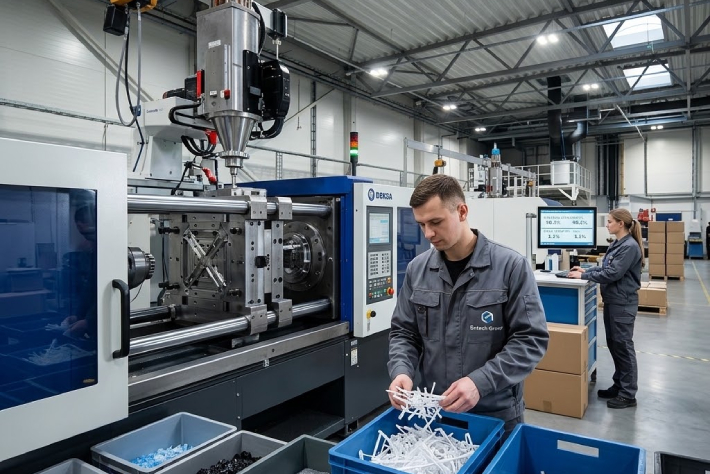
ISO 9001 and Injection Moulding
For an injection moulding company, quality is about more than simply producing parts that look good. The company needs to consistently produce parts that meet customer requirements while controlling the processes behind them.
This is where ISO 9001 comes in.
ISO 9001 provides a framework for managing quality throughout the business. In an injection moulding environment, this can cover areas such as customer requirements, drawings and specifications, production processes, machine settings, material control, employee training, inspection and testing, supplier management, and the handling of non-conforming parts.
For example, if a customer changes a drawing or specification, the company needs a reliable way to ensure that the change is reviewed, approved, documented, and communicated to the people who need to know about it.
Similarly, if a batch of parts is found to be out of specification, there should be a clear process for identifying the problem, controlling the affected parts, investigating the cause, and taking corrective action to prevent the problem from recurring.
ISO 9001 also encourages companies to monitor their processes and use data to identify problems and opportunities for improvement.
In an injection moulding environment, this could mean monitoring:
Scrap rates
Machine downtime
Customer complaints
Process performance
Recurring defects
Rework
Delivery performance
The benefits are practical. Better process control can reduce scrap, rework, downtime, and customer complaints. It can also make production more consistent and reduce the risk of problems being passed on to the customer.
ISO 9001 certification can also be important commercially. Many larger customers want suppliers to demonstrate that they have a reliable quality management system. Certification can therefore help an injection moulding company meet customer requirements and compete for new business.
Ultimately, ISO 9001 is about having a controlled and repeatable way of managing quality. It does not guarantee that every part a company produces is perfect. Instead, it provides a structured system for meeting requirements, identifying problems, taking corrective action, and improving over time.
ISO 14001 and Injection Moulding
Today, efficiency in manufacturing is about more than cycle times and part quality. Environmental impact is also becoming an increasingly important part of how manufacturing companies operate.
This is where ISO 14001 comes in.
ISO 14001 is the international standard for Environmental Management Systems (EMS). It provides a framework for identifying environmental impacts, meeting relevant legal requirements, setting objectives, and continually improving environmental performance.
For an injection moulding company, there are several areas where this can make a practical difference.
Injection moulding machines and auxiliary equipment can consume significant amounts of electricity. The process can also generate plastic waste in the form of runners, sprues, and rejected parts. Hydraulic fluids, cooling water, packaging materials, and other substances can create additional environmental risks if they are not properly managed.
ISO 14001 helps a company address these issues systematically.
Using the Plan-Do-Check-Act (PDCA) approach, the company identifies its main environmental impacts, sets objectives and targets, takes action, and then checks whether those actions are actually working.
For example, a moulding company might reduce energy consumption by upgrading older machines or installing more efficient equipment. It might reduce plastic waste by optimizing processes, improving first-time quality, or using granulators to reprocess suitable scrap where appropriate.
It could also look at reducing water consumption, improving the handling of hydraulic fluids, reducing packaging waste, or selecting materials and processes with a lower environmental impact where technically and commercially appropriate.
There are clear business benefits as well. Using less electricity and reducing material waste can lower operating costs. A well-managed environmental system can also help a company keep track of environmental legislation and reduce the risk of non-compliance.
There is a commercial side to ISO 14001 as well. Large customers, particularly in industries such as automotive, medical, and consumer goods, increasingly expect suppliers to demonstrate effective environmental controls. In some cases, ISO 14001 certification may even be a requirement for becoming or remaining an approved supplier.
So, ISO 14001 is not simply about ticking an environmental compliance box. For an injection moulding company, it can be a practical way to reduce waste, control costs, manage environmental risks, meet customer expectations, and improve the way the business operates.